Posts

Showing posts with the label Frederick Schleiermacher

Schleiermacher: The Christian Faith, 86-156
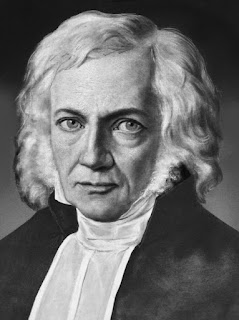
Image
           This is the fourth in a series on Frederick Schleiermacher.             Schleiermacher will now have a much longer exploration of grace (86-169) as the experience of vital fellowship that brings moral transformation. The present sense of the Christian fellowship consists of the need humanity has for redemption. This awareness is the basis for his concept of Jesus as the Redeemer. Tillich will admit that much of his discussion of Jesus as the New Being is similar to what Schleiermacher says here, although he cautions that they are not identical presentations. [1] Schleiermacher begins with Christian consciousness and asks how it posits the redeemer. [2] He is trying to derive the contents of the Christian faith from the Christian consciousness. The Lutheran School of Erlangen sought to do something similar. Such an attempt is an illusion. The event on which Christianity has its...

Schleiermacher: The Christian Faith, 62-85

Image
             This is the fourth in a series of reflections on Fredrick Schleiermacher. This one will focus upon his Doctrine of Sin.            Schleiermacher continues to affirm that every doctrine must connect with the religious or pious self-consciousness. Christian experience is aware of sin and grace (62-64). He will direct us to dogmatic statements concerning the self and then to the hints they provide of dogmatic statements we can make about God. He will remind us that if a person becomes aware of the divine attributes, as he understands them in the previous section a person is already turning toward God.             He begins with his exploration of sin (65-85). We have awareness of sin only because we have a sense of what is good and best. Thus, our intuition of the Infinite is only in apparent contradiction with our awareness of sin. Sin is our ...

Schleiermacher: Christian Faith, 32-61

Image
The Christian Faith, Sections 32-61             In these sections, Schleiermacher explores the feeling of our absolute dependence further. The religious self-consciousness is an intuition that our limits of space and time, our finitude, depend upon a larger unity of the universe. When we become conscious of this dependence, we are on a journey toward the discovery of the meaning of our lives. We have an openness to that which transcends us. Schleiermacher would call such transcendence the Infinite, the Universe, or the All. We will not discover such meaning through insisting upon our isolated individuality. Individuals are not islands. The implication is that we do not discover meaning by focusing simply upon self. Rather, we discover meaning in our engagement with or openness to the world. Meaning comes from beyond us as isolated individuals.              Such a r...