Posts

Identifying God with Kathryn Tanner

Image
       This is a brief portion of a chapter on which I am working on identifying God. I am doing so primarily with Wolfhart Pannenberg in this Systematic Theology. However, I have recently been reflecting with Kathryn Tanner. I hope the following is at least a start on the topic of the divine and human relation.        Sixth, another part of this conversation in identifying God is the notion of the spiritualty, knowledge, and will of God. Most of us would assume such things of God. Such language is personalist. It suggests we have a psychological disposition to appeal in worship to what is like oneself. Yet, such language is a useful way for us to talk about God as a creative agent. [1] Yet, such anthropomorphic notions came under suspicion through Spinoza, Hume, Fichte, and Feuerbach. To take one example, to refer to divine intelligence is a metaphor similar to saying God is a rock or light. Interestingly, Hegel view...

The God Who Saves by David Congdon

Image
I have had the privilege of interacting with the author of this book on twitter. I also have the privilege of being in a reading group that explores the thoughts of various theologians. We chose this book, and I am glad we did. We have an existential approach that focuses on salvation as the center of systematic theology and offers a basis for universalism. This means he is working on reviving dialectical theology for this century. Even if you don't agree you will have much to ponder.      Does humanity need saving? If so, does salvation come from outside of us or does it arise from within and among us? These are two questions that this book at least makes me ponder. Does humanity have a saving end? Alternatively, does humanity as a whole, do we as individuals, fade to black, as the end of the TV show Soproanos suggested?      One of the many insights I have found helpful is the need to bring the Spirit into our unders...

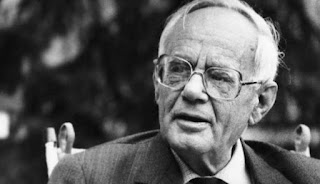
Karl Rahner

Image
Karl Rahner 2017 Contents Introduction . 1 Philosophical Anthropology . 2 Trinity . 8 Creation . 11 Christology . 11 Christian Life . 17 Eschatology . 20     Introduction         I am reflecting upon the ways in which Roman Catholic Jesuit priest and theologian Karl Rahner (1904-84) has influenced the way I have come to engage in the theological enterprise. I have found him quite insightful. I have not found him as helpful in working through a view of the church. He is too Roman Catholic for me. I respect his view that the church is a sign or provisional representation of the rule of God. Thus, it should never confuse its historical presence with that rule. [1] However, in important junctures of theological reflection, he has offered much that I have found agreeable. Pannenberg notes that the term “transcendental” by Rahner refers structural relation of anthropology, theology, and Christ...