Posts

Chapter 3

Image
Chapter 3 continues a discussion by Pannenberg of his philosophy of religion by specifically considering the reality of the divine (God and the Gods) in the experience of the religions. He is still not ready to discuss Christian teaching. He is still preparing the ground, so to speak. He continues to offer his apologetic in convincing the reader that discussion of Christian teaching remains a credible endeavor. He will now wrestle with the challenge presented by the plurality of the religions in light of the quest for truth. He will present criteria for how one could make a reasonable judgment regarding the truth or falsity of a particular religion. Section 1 deals with the concept of religion and the role it has in theological reflection. The breakdown of the inspiration and authority of the Bible in the 16-1700s led to increased focus upon the nature of religion. The work of W. C. Smith, The Meaning and End of Religion (1964) is helpful to Pannenberg at this point. Pannenberg w...

Chapter 2

Image
In Chapter 2, Pannenberg will explore the concept of God and the question of its truth. The chapter is actually an exploration into the philosophy of religion. To offer yet another contrast with Karl Barth, here is a chapter that Barth would say no theologian should write. Barth begins quickly in his prolegomena to proclaim the Word of God and revelation. In contrast, Pannenberg thinks that to gain a hearing for the Christian message, one needs persuade others that the discussion of God is still credible, valuable and meaningful. I will divide this chapter into two considerations, one being whether the word “God” is still meaningful in a secular culture, and the other is the yes Pannenberg gives to the notion of a natural knowledge of God and the no he gives to natural theology.            The challenge of secularity is always before him. In this case, he thinks that the mention of God or the divine sounds like a holdover from a childish and superstiti...

Chapter 1

Image
          In Chapter 1, Pannenberg wants to explore the way in which truth needs to be the theme of any exploration into Christian teaching. If one reads this chapter carefully, the result will be a thorough grasp of the approach to the theological task that Pannenberg will develop throughout the three volumes. For example, “theology” refers to the divine as the all-embracing founding principle of all being. In Plato, illumination is the result of dialectical reasoning. He will want to stress that God makes possible the knowledge of God through revelation. Truth is the theme of theology, and not just the training of the leaders of the church. Theology is not simply a “practical” or “moral” discipline. Therefore, theology has a deep ambiguity in that it may be nothing more than human talk and therefore not be theology at all. Theology, he thinks, must include the act of advocating for the truth of Christian discourse about God. As such, it must be able to f...

Introducing Pannenberg

Image
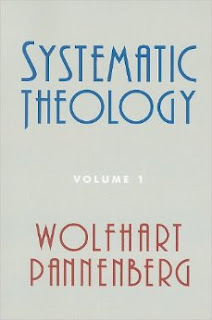
     My introduction to German theologian Wolfhart Pannenberg was a class at Asbury Seminary in 1975. His Basic Questions (1967, 1971) was a series of essays that I found challenging. I read his Jesus: God and Man (1964, 1968) as I got into being pastor of churches. He did not write his Systematic Theology 1988 and Geoffrey W. Bromiley did not complete the English translation until 1991. I was excited, devouring the book.   Although I did not have the pleasure of meeting him, he has been my teacher through the years. He wrote Theology and the Philosophy of Science in 1973 and Anthropology in a Theological Perspective in 1985. Given his approach to theology, these were two books he needed to write before he could he write his Systematic Theology.             My journey with Pannenberg is a gift that has kept giving. One reason his writings have attracted me is his insightful reflection on Hegel. My...